
Marshall County Court Records After a Jail Arrest
An arrest and a court record are two different things, and the gap between them trips up a lot of searches. After someone is arrested and booked in Marshall County, the State's Attorney reviews the case and decides what formal charges to file. Those filed charges open a case in the circuit court, and that case is the court record. The sheriff and arresting agency may list early booking charges, but the prosecutor's filed charges are what control the criminal case.
The booking and custody side lives elsewhere. For the roster and booking detail, the Marshall County jail inmate records page covers how to confirm custody, and booking photos are handled on the jail mugshots page. This page stays on the court records that follow an arrest: the charges the prosecutor filed and how the case moves through the Marshall County courthouse.
That courthouse is the hub for every filed case. The Illinois Courts directory lists its address, hours, and circuit. A look at the Marshall County Courthouse directory page confirms the one-courtroom setup that handles all case types.
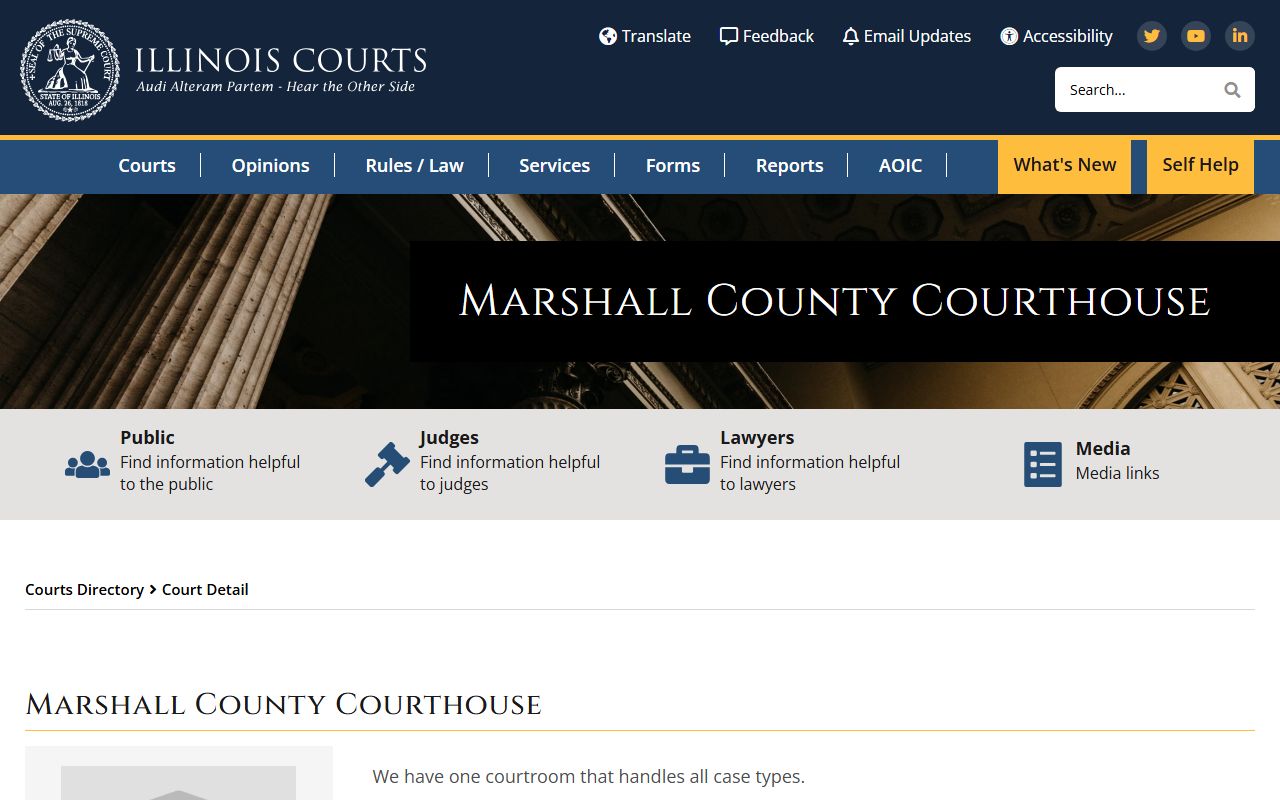
Because the county has one courtroom, a person is not navigating separate criminal, traffic, and felony buildings. Every filed case after an arrest points back to the same courthouse and the same circuit clerk in Lacon.
How to Find Marshall County Court Records After an Arrest
The pathway from custody to a searchable court record runs in a fixed order: arrest, then booking at the jail, then a first appearance, then the prosecutor's charging decision, then the case opens with the Circuit Clerk. The court record becomes useful to search once the case is opened or updated in the clerk's system, which is usually after that first appearance and charging step.
The circuit clerk keeps the records of the court and links the public to them. The official Circuit Clerk page points to Marshall County Online Court Records, which opens the Judici case-search platform. Judici is operated by a private vendor, not the court, so use it for the search but get official or certified copies from the Circuit Clerk.
- Open the Circuit Clerk page and follow the Marshall County Online Court Records link to Judici.
- Search by defendant or party name, or by a case number if you have one.
- Confirm the court is Marshall County, Illinois, then open the case to read the charge list.
- Check each charge's statute, count, level, and current status, along with the next court date.
The Judici search page shows the fields used to pull a Marshall County case after an arrest. A glance at the Judici Marshall County case search shows the name and case-number search the clerk page links to.
For older, sealed, or unavailable files, contact the Circuit Clerk directly. The clerk's office in Lacon can pull records that are not online and issue certified copies that Judici does not provide.
How Charges Get Filed After an Arrest
Walk the path forward from the arrest. Booking happens at the jail, and then the charge record begins when the prosecutor files a charging document in the circuit court. Three document types start most cases, and the one used depends on how serious the offense is.
| Complaint | Information | Indictment | |
|---|---|---|---|
| Filed By | Officer / Prosecutor | State's Attorney | Grand Jury |
| Common For | Many misdemeanors | Many felonies | Serious felonies |
| Starts | The case | The case | The case |
A complaint often appears early after an arrest and can be amended later. An information is the prosecutor's formal charge. An indictment comes from a grand jury. A warrant can also drive the process: an arrest warrant can produce the booking, and a later failure to appear can produce a bench warrant that leads to another booking.
Charge Status in Court Records After an Arrest
Charges change as a case moves, and the court record tracks each change. Booking charges on the arrest side can differ from the charges the prosecutor finally files, so the docket is the place to confirm what a person actually faces. The common status terms are defined below.
| Status | What It Means |
|---|---|
| Pending | The charge or case is still open and moving through the court. |
| Amended / Reduced | The prosecutor changed or lowered the charge or count. |
| Dismissed | The charge or case was removed by court or prosecutor action. |
| Nolle Prosequi | The prosecutor declined to proceed on a charge. |
Note: A same-day search can come up empty because the person has not had a first appearance, the prosecutor has not filed charges yet, or the clerk has not indexed the case online.
Pretrial Release and Bond After an Arrest
Illinois changed how release works, and older jail pages get this wrong. The Pretrial Fairness Act took effect on September 18, 2023, and Illinois no longer uses cash bail as a condition of pretrial release. Instead, the court decides release conditions, and detention in eligible cases, based on statutory factors rather than a dollar amount. The core statute, 725 ILCS 5/110-5, tells the court to weigh the offense, the evidence, the person's history, and the risk to safety, and to impose the least restrictive conditions needed.
| Term | How It Works |
|---|---|
| Pretrial Release | The court sets the least restrictive conditions needed to ensure appearance and safety. |
| Detention | The court may order pretrial custody in eligible cases when statutory standards are met, under 725 ILCS 5/110-6.1. |
| Conditions / Monitoring | Electronic monitoring or check-ins may apply, subject to findings and review. |
| Holds / Detainers | A hold from another agency can keep a person in custody even if the local case changes. |
To track a release decision, search the court docket for the pretrial order and the next court date, and call the jail for current custody. The Circuit Clerk can answer docket questions and provide official copies.
Warrants That Lead to an Arrest
No official public Marshall County warrant search was located, so warrant questions run through the sheriff, the court docket, and counsel. The sheriff page says deputies serve warrants and the Administrative Division processes them, but there is no online warrant database. A bench warrant tied to a filed case can show up in the court docket on Judici, which is the practical public trail.
If you believe there is an active warrant, speak with an attorney before walking into a law-enforcement office, since an active warrant can lead to an arrest and a booking at the Marshall County Jail. A search warrant is different from an arrest or bench warrant; it authorizes a search and does not by itself mean a person is booked.
Charges vs. Convictions
Being arrested and charged is not the same as being convicted, and court records keep the two stages separate. An arrest is an accusation and a custody event. A charge is a prosecutor and court event. A conviction is a final finding of guilt by plea or verdict. Reading "arrested for" as "convicted of" is a common and serious error.
| Charge | Conviction | |
|---|---|---|
| Stage | Accusation | Verdict or plea |
| Burden of Proof | Probable cause | Beyond a reasonable doubt |
| Public Record | Yes | Yes |
Sealed vs. Expunged Records After an Arrest
Illinois lets eligible people clear an arrest or court record through expungement or sealing. The main route is 20 ILCS 2630/5.2, and the Illinois Office of the State Appellate Defender publishes the forms accepted in Illinois courthouses. Sealing hides a record from most public view, while expungement treats it as though it never existed. The two differ in visibility and eligibility, as the table shows.
| Sealed | Expunged | |
|---|---|---|
| Visibility | Hidden from most public access | Destroyed or treated as never existed |
| Law Enforcement | Limited access | Very limited access |
| Eligibility | Set by Illinois statute and disposition | Narrower; often for dismissals and eligible arrests |
The Illinois State Police Bureau of Identification and the Appellate Defender route applicants to the proper forms, so a person seeking to clear a Marshall County record should start there rather than with any private service.
Background Check Considerations
There is a difference between a casual public-record lookup and a regulated background check. Court records after an arrest are public, but using them to make hiring, housing, lending, or insurance decisions falls under the federal Fair Credit Reporting Act, which has its own rules and authorized providers.
Important: This site is not a consumer reporting agency under the FCRA, and its information may not be used for employment, tenant, credit, or insurance screening.
Restricted Court Records After an Arrest in Marshall County
Not every record after an arrest is open. Juvenile cases are restricted, and the county does not house juveniles at the jail. Sealed and expunged charges drop from public view, and some dismissed charges can be withheld. Records tied to an ongoing investigation, victim or witness information, and certain medical or privacy data may also be limited under Illinois FOIA exemptions.
When a record you expect to find is missing, the cause is often one of these restrictions rather than an error. For a case that should be public, the Circuit Clerk can confirm whether a file exists and how to request it, while the State's Attorney handles the charging side.
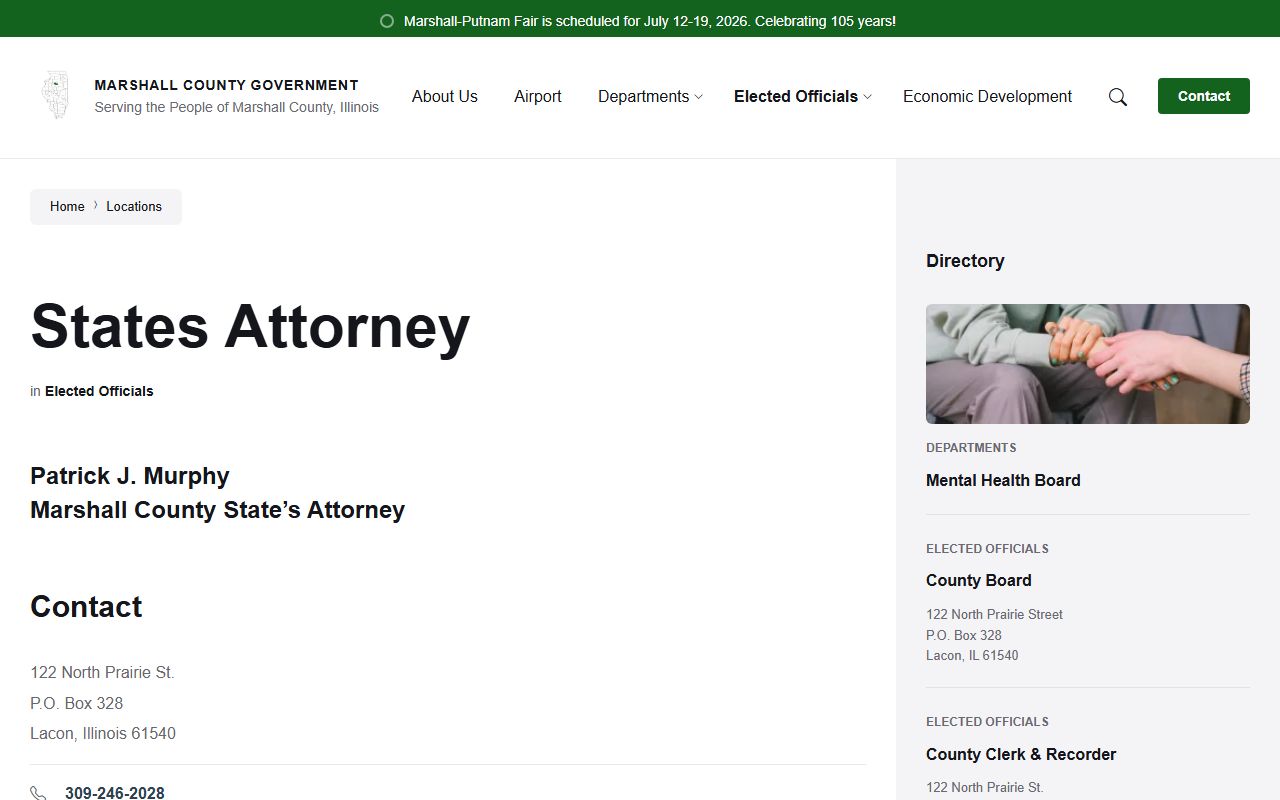
The Marshall County State's Attorney page lists the prosecutor's contact details, useful when a question is about the charges themselves rather than the court file.